The Astonishing Transformation: How a £450 Peugeot 106 Rallye Became a £12,000 Modern Classic
For a decade and a half, Dave Partridge has nurtured a car that many would have consigned to the scrapyard. His journey with the Peugeot 106 1.3 Rallye is a testament to passion, perseverance, and the often-unforeseen appreciation of automotive history. What began as a £450 project, intended for the visceral thrill of hillclimb racing, has evolved into a highly desirable modern classic, now valued at an impressive £12,000. This is the story of how strategic restoration, an unwavering commitment to authenticity, and a keen eye for a future icon transformed a neglected hot hatch into a prized possession.
The initial vision for Dave’s Peugeot 106 Rallye was rooted in the competitive arena of motorsport. He acquired the vehicle thirteen years ago with the express purpose of participating in hillclimb and sprint events within the up-to-1300cc category. “I poured everything I could into making it competition-ready, adhering strictly to the regulations,” Dave explains. “I fitted Bilstein Group N Tarmac suspension, aiming for peak performance. However, just as I was ready to hit the track, the rules changed, increasing the class capacity to 1.6 liters. This effectively rendered my meticulously prepared car ineligible for the events I’d envisioned. It was a significant setback at the time.”
Looking back, this rule change proved to be a fortuitous turn of events. The Peugeot 106 Rallye, particularly the 1.3 iteration, has since cemented its status as a genuine modern classic. It’s a model that resonates deeply with automotive enthusiasts and collectors alike, prized for its raw driving dynamics and analogue feel. Dave’s particular example is a 1995 model, which, despite its extensive mileage of 160,000, retained the vital original engine and gearbox – components that are increasingly difficult to source and central to the car’s authenticity. “When I first bought it, it was the epitome of a ‘boy racer’ car,” Dave recalls. “It had tinted windows, garish LED washer jets, and an oversized rear spoiler. None of that detracted from my interest; I was focused on the core mechanicals – the engine and gearbox. Those are the irreplaceable elements.”
The mechanical heart of the car was intact, but its bodywork was a different story. The fundamental construction of these cars, with their painted steel chassis, made them susceptible to corrosion. “The chap tasked with rebuilding it initially advised me to scrap it due to the extent of the rust,” Dave admits. “Thankfully, he persevered, and the underlying structure has been completely revitalized. It’s now structurally sound, like a new car from beneath.”
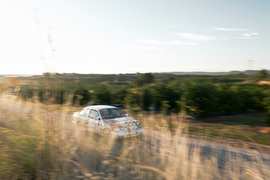
However, Dave intentionally chose a different path for the car’s exterior aesthetic. Instead of a pristine, factory-fresh finish, he embraced what he calls “patina.” The paintwork exhibits a faded, even blistered, appearance, particularly on the roof, and the once vibrant red and yellow decals have softened to a pale white. This deliberate choice reflects a deeper philosophy. “I have a profound appreciation for cars that authentically wear their age,” Dave states. “My primary objective is to preserve the car’s originality as much as possible. For instance, I replaced the aftermarket fog lights with the correct original vents. These are specific to the Series 1 Rallye models like mine, and finding them was an arduous, nine-year quest.”
Remarkably, while the exterior tells a story of years gone by, the interior remains a time capsule. The seats, dashboard, door cards, headlining, and carpeting are all original and in immaculate condition, as if the car had just rolled off the production line. This contrast between the weathered exterior and the pristine interior only adds to the car’s unique charm and narrative.
Dave’s passion for his 106 Rallye is palpable and deeply rooted in its unadulterated driving experience. “I adore its lightness and the complete absence of power steering or intrusive ABS systems,” he enthuses. “It offers a truly pure driving sensation. Compared to a rapid modern car, you feel like you’re pushing the limits, yet you glance at the speedometer and you’re only doing 65 mph! This allows for exhilarating fun at much safer speeds, where you can truly feel connected to the road and the machine.”
The car’s mechanical enhancements, while subtle, amplify its character. The five-speed gearbox, a crucial element for its spirited performance, has been professionally rebuilt and features incredibly short ratios. The engine benefits from a high-lift camshaft and a Supersprint manifold, allowing it to rev enthusiastically to around 7200 rpm. “This car truly comes alive when you’re wringing its neck,” Dave explains. “It’s a spirited little terrier that demands to be driven hard. It’s certainly not designed for languid motorway cruising.”
Dave’s automotive interests extend far beyond his beloved 106 Rallye. His personal collection boasts a diverse array of vehicles, reflecting a broad appreciation for automotive engineering and design. “I currently own six cars and four motorcycles,” he shares. “My car stable includes a robust Volvo 240 estate, a classic ‘E30’ BMW 325i Touring, a 2005 Subaru WRX – my most contemporary acquisition – a formidable ‘C5’ Audi RS6, which serves as my practical ‘dog wagon,’ and a charmingly retro Mini. I’m also actively seeking to expand my collection further, with a Jaguar XJS V12, a Morris Oxford, and an Alfa Romeo Giulia on my wish list.” His philosophy on car ownership is clear and heartfelt: “For me, cars are akin to beloved pets; I never part with them. They become integral members of the family.”
The transformation of Dave’s Peugeot 106 Rallye from a £450 competition project into a £12,000 modern classic underscores several critical trends in the current automotive market. The rising appreciation for analogue driving experiences is a significant factor. In an era of increasingly complex and electronically assisted vehicles, a growing segment of enthusiasts is seeking out cars that offer a more direct and engaging connection with the road. The Peugeot 106 Rallye, with its lightweight construction, manual gearbox, and lack of driver aids, perfectly embodies this desire. This trend is driving up the value of hot hatch classics and performance hatchbacks.
Furthermore, the concept of automotive patina has gained significant traction. Rather than solely focusing on concours-level restoration, many collectors now value cars that retain their original character and signs of age. This approach, often referred to as preservationist restoration or restomod with character, acknowledges the car’s history and provenance. It’s a stark contrast to the often-overdone, immaculate restorations that can sometimes strip a classic car of its soul. This focus on original condition classics is particularly relevant for models like the 106 Rallye, which were not inherently luxury vehicles but performance-oriented machines designed for enthusiastic driving.
The story also highlights the enduring appeal of budget performance cars that have transcended their original market positioning. The Peugeot 106 Rallye, when new, was an accessible performance car. Today, its limited production numbers and its reputation for pure driving dynamics have elevated it to a status previously reserved for more exotic machinery. This phenomenon is influencing the market for affordable performance classics and future classic cars.
For those considering investing in or restoring a similar vehicle, understanding the classic car market trends is paramount. The appreciation for lightweight sports cars and driver-focused hatchbacks is likely to continue. Furthermore, the emphasis on originality and provenance in the classic car world means that cars with intact original engines and gearboxes, like Dave’s 106 Rallye, will always command a premium. The meticulous attention to detail, such as sourcing period-correct parts like the original vents, is a key differentiator.
The story of Dave Partridge and his Peugeot 106 Rallye is more than just a tale of a car’s monetary value increasing. It’s a narrative about the enduring spirit of automotive passion, the wisdom of seeing potential where others see obsolescence, and the satisfaction of preserving a piece of motoring history. It serves as an inspiration for fellow enthusiasts, demonstrating that with dedication and a clear vision, even the most neglected vehicles can be reborn into objects of desire and significant value.
If you, too, have a project car or a classic you believe holds untapped potential, or if you’re looking to acquire a vehicle that offers a truly engaging driving experience and possesses the hallmarks of a future classic, now is the opportune moment to explore the possibilities. Engaging with experienced classic car specialists or researching the current market for performance car valuations can provide invaluable insights. Don’t let your automotive dreams remain in the realm of what-ifs; take the next step and discover the extraordinary stories waiting to unfold.