
The Volkswagen Golf GTE: A Company Car Conundrum for the Driving Enthusiast in 2025
For over a decade, the automotive landscape has been in a constant state of flux. As an industry expert with ten years immersed in this dynamic sector, I’ve witnessed firsthand the evolution of consumer priorities, technological advancements, and the ever-shifting economic forces that shape our purchasing decisions. One of the most significant transformations has been the burgeoning popularity of company car schemes and salary sacrifice programs. These initiatives, once niche options, have become mainstream, offering a compelling pathway for many to access new vehicles, particularly appealing to those who relish their daily commute and the driving experience itself.
The allure of a company car, especially through salary sacrifice, lies in its inherent financial advantages. By having payments deducted pre-tax, individuals can effectively reduce their taxable income, leading to significant savings compared to traditional financing methods like Personal Contract Purchase (PCP), Hire Purchase (HP), or private leasing. While the long-term ownership aspect is absent, and a Benefit-in-Kind (BIK) tax liability exists, the net financial benefit for many employees is undeniable. This economic reality has prompted manufacturers to strategically position certain models within this lucrative segment, and the Volkswagen Golf GTE has emerged as a particularly intriguing contender, especially for those who demand a blend of spirited performance and fiscal prudence.
The question I’ve been exploring over a substantial 4000-mile test drive isn’t simply whether the Golf GTE is a good car, but rather, is it the right car for a driving enthusiast who benefits from a company car scheme? Can its plug-in hybrid (PHEV) technology, combined with the Golf’s inherent DNA, truly satisfy a palate accustomed to performance hatchbacks, while simultaneously delivering the economic benefits that drive its selection in the first place? This deep dive aims to provide a comprehensive answer, informed by real-world experience and current market trends in 2025.
The Allure of the Hybrid Hatchback: Performance Meets Efficiency
At the heart of the Volkswagen Golf GTE’s appeal is its sophisticated plug-in hybrid powertrain. This system artfully combines a 1.5-liter turbocharged four-cylinder petrol engine, producing 160 horsepower, with a potent 108-horsepower electric motor. The combined output culminates in a robust 268 horsepower, all channeled to the front wheels through a lightning-quick six-speed dual-clutch automatic transmission (DSG). This powertrain configuration is not merely about numbers; it’s about delivering a driving experience that can be both invigorating and remarkably economical.
One of the most significant advancements in the latest iteration of the GTE is its substantial 19.7 kWh battery. This allows for an impressive official electric-only range of up to 81 miles. For context, this figure significantly eclipses that of many competitors, including the Mercedes-Benz A250e, which typically manages around 44 miles on electric power alone. This extended electric range is a game-changer, offering the potential for a considerable portion of daily driving to be completed with zero tailpipe emissions and at a fraction of the cost of traditional petrol power.
However, as with any PHEV, there’s a symbiotic relationship between charging and fueling. The GTE necessitates both plugging in to replenish the battery and visiting the petrol station to keep the internal combustion engine satisfied. For drivers like myself, who may not have convenient home charging solutions, the viability of a PHEV hinges on its flexibility and the practicality of public charging infrastructure. Thankfully, the GTE’s compatibility with DC fast chargers significantly alleviates this concern, allowing for rapid top-ups when opportunities arise. This is a critical development in the PHEV space, making them far more appealing to a wider demographic.
Design and Interior: The Golf’s Familiar Charm, Enhanced
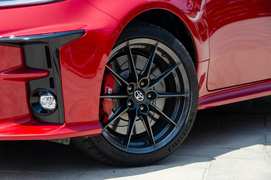
Visually, the Golf GTE strikes a compelling balance between the mainstream Golf and its more potent GTI sibling. The front-end design shares the aggressive, purposeful stance of the GTI, but the GTE sits at a slightly higher ride height, akin to a standard Golf. While the GTI often sports distinctive wheels and a more overt exhaust note, the GTE’s exhaust system is discreetly hidden, contributing to its more understated, yet undeniably sporty, aesthetic. The optional Crystal Ice Blue paint, as featured on my test car, adds a layer of sophistication that elevates its visual appeal further. While some might find the illuminated badges a touch ostentatious, they are a subtle nod to the car’s technological prowess.
Step inside, and the GTE embraces the modern Golf interior philosophy. A dominant 12.9-inch central touchscreen serves as the command center, controlling most of the vehicle’s functions. Physical buttons are minimized, primarily residing on the multifunction steering wheel. The interior is adorned with a generous amount of gloss black trim, which, while stylish, can be prone to fingerprinting. Standard features include wireless phone charging, a welcome convenience. The seats are sport-oriented, upholstered in a striking Jacara checked cloth with a distinct blue and white pattern, reminiscent of the GTI’s iconic tartan but with a unique GTE flair. These seats proved exceptionally comfortable, even on extended journeys, a crucial factor for a car intended for frequent use.
However, the practicality of the interior is where the GTE faces a slight compromise. The integration of the substantial battery pack beneath the boot floor has reduced cargo capacity to a modest 273 liters, a noticeable reduction from the standard Golf’s 381 liters. This is a factor that prospective buyers, especially those with families or a penchant for carrying larger items, will need to carefully consider.
The Driving Dynamics: More Than Just the Badge
My initial experiences behind the wheel of the GTE were overwhelmingly positive. While it’s crucial to acknowledge that the GTE isn’t a direct replacement for the purist’s choice, the GTI, its sporty pedigree undeniably shines through. The steering is commendably weighted and responsive, providing a direct and engaging connection to the road. The chassis feels commendably stiff, offering a secure and composed feel when navigating corners, even when pushing the pace. For a car that carries the additional weight of its hybrid components and is often positioned as a cost-effective company car option, the GTE delivers a surprisingly spirited and enjoyable driving experience.
Navigating the Hybrid Maze: Optimizing Performance and Economy
One of the inherent challenges with any plug-in hybrid is mastering its complex energy management system. My personal philosophy leans towards experimentation and deep dives into vehicle technology, and the Golf GTE presented a perfect opportunity for this. The initial setup required a fair amount of “fiddling” with the comprehensive touchscreen interface to configure the vehicle to my preferences. This included disabling certain mandatory safety systems, such as the lane-keeping assist and speed limit warnings, which, while well-intentioned, can become intrusive and require re-activation upon each ignition cycle. I customized my own drive mode, opting for the “Sport” drivetrain setting for spirited acceleration, while configuring the adaptive dampers of the 15-way adjustable Dynamic Chassis Control to “Comfort” for everyday driving refinement.
The true test of the GTE’s hybrid efficiency, particularly without the convenience of home charging, emerged during a series of extended round trips. With a full tank of fuel and a fully charged battery, the initial range indicators suggested ample capability. My strategy was to meticulously manage the electric range across multiple journeys, aiming to maximize the use of electricity. However, the initial learning curve proved steep.
My first commute saw the GTE operating in its default E-mode, running exclusively on electric power. While this is desirable for zero-emission driving, it rapidly depleted the battery without the engine engaging, which was not my intended approach for the multi-trip scenario. Switching to Hybrid mode, the petrol engine gracefully awakened, but I quickly discovered the GTE’s aversion to defaulting to Hybrid mode upon startup – a point of mild frustration.
Further experimentation revealed the nuanced controls for battery management. A “manual control” setting allowed me to dictate a desired battery charge level upon arrival. My initial attempts to have the system intelligently spread the charge across the journey were met with disappointment. The battery was often depleted within the first 20 miles, leaving the petrol engine to shoulder the remainder of the journey. This highlighted a crucial learning: the car needs explicit instruction regarding journey duration and intended use to effectively manage its hybrid powertrain.
It wasn’t until I began meticulously entering my destination into the Volkswagen native navigation system, rather than relying solely on Apple CarPlay or Android Auto, that the GTE’s intelligence began to truly unlock. Road testers had hinted at this, and indeed, when the car’s internal mapping system was engaged, the GTE demonstrated a more sophisticated approach to energy deployment. It still wasn’t flawless, and occasionally the allocated electric charge was consumed more rapidly than anticipated, but the overall efficiency improved dramatically.
Over the course of a week, encompassing nearly 400 miles of mixed driving, my experimental approach yielded an astonishing average of 77 miles per gallon (mpg). This figure is truly impressive, especially when contrasted with the 52 mpg achieved when running solely on the 1.5-liter TSI engine. The hybrid system, even when starting with minimal battery charge, proved adept at recapturing energy through regenerative braking, significantly augmenting overall efficiency. This begs the question: does the daily effort of charging and careful configuration justify the substantial increase in fuel economy? For me, the answer is a resounding yes. The cost of charging the battery, even using public infrastructure, was comparable to half a tank of petrol, yet the efficiency gains were undeniable. The key, it seems, lies in the optimal blending of electric and petrol power, a skill that becomes more intuitive with familiarity.
Challenging Perceptions: Is the GTE a True Enthusiast’s Car?
The “hot hatch” moniker often evokes images of raw performance, visceral feedback, and an unadulterated connection between driver and machine. Some critics, including fellow automotive journalists, have suggested that the Golf GTE, despite its sporting aspirations, lacks the soul and outright engagement of its GTI counterpart. They argue that it possesses the “gear” but not the “idea,” projecting a sporty persona without fully delivering on the enthusiast’s desire for dynamic thrills.
I understand this sentiment. The GTE doesn’t possess the same razor-sharp steering feel or the intoxicating soundtrack of the GTI’s renowned EA888 engine. The added weight of the battery pack is also subtly perceptible. However, to dismiss the GTE solely on these grounds would be to overlook its unique strengths and its appeal to a broader spectrum of driving enthusiasts.

My personal exploration involved deliberately deviating from my usual routes, opting for the winding B-roads and A-roads that offer a more engaging driving experience. And I found myself genuinely enjoying the process. The GTE offers a potent and immediate surge of acceleration, courtesy of the electric motor’s instant torque, which is particularly exhilarating out of tight corners. When the petrol engine joins the fray, the combined power delivery is strong and confident. The steering, while not as communicative as the GTI’s, provides ample weight and precision to inspire confidence. Grip levels are tenacious, and the chassis remains commendably composed, with body roll kept impressively in check. While the GTE might not relentlessly egg you on to push its limits, it certainly responds with enthusiasm and composure when you decide to explore its capabilities. The ultimate test for any enthusiast’s car is whether it inspires you to drive it for the sheer joy of it. While I may not be waking up at dawn for a dedicated GTE blast, I find myself consistently opting for the slightly longer, more scenic route home – a clear indicator of its inherent appeal.
Versatility Beyond Expectation: A Hatchback That Can Do It All
In an era dominated by SUVs, the traditional hatchback’s appeal has undeniably waned. SUVs now command a significant majority of new car sales, offering practicality, elevated driving positions, and generous interior space. While I’ve previously lauded the practicality of SUVs, my extended tenure with the Volkswagen Golf GTE has profoundly shifted my perspective. Over approximately 2000 miles, the GTE has proven itself to be a remarkably adaptable and capable vehicle, often exceeding expectations for its segment.
The true test of a car’s versatility lies in its ability to handle a diverse range of tasks. During my time with the GTE, I encountered situations where larger vehicles might have been perceived as necessary. One such instance involved transporting a group of friends and their accompanying gear to a festival. While an enormous Mazda CX-80 proved its mettle in that scenario, the GTE subsequently demonstrated its prowess during a significant flat clear-out. We successfully managed to fit a television, its stand, numerous boxes of clothes, and other assorted items into the GTE with the rear seats folded down, utilizing its full 1162 liters of cargo capacity, while still maintaining comfortable seating for two in the front. Later that week, the GTE accommodated a rather large 55-inch television, requiring the rear seats to be folded and the front seats to be moved forward – a tight squeeze, but achievable.
This adaptability continued with several 200-mile-plus round trips, all of which the Golf dispatched with remarkable ease, efficiency, and without any sense of struggle. Even a journey to Bristol, requiring accommodation for all five occupants and their luggage, was handled commendably. While the rear passengers were in close proximity, they reported no significant discomfort. The GTE’s ability to seamlessly transition from urban commuting to longer road trips, from carrying bulky items to transporting multiple passengers, is a testament to its well-rounded design. Its compact 4289mm footprint made parking a breeze, the infotainment system kept us entertained, and the sporty chassis setup ensured an engaging drive regardless of the distance. While I still lament the slightly diminished boot space and the somewhat drab interior color palette, these are minor concessions given the GTE’s overall competence. It stands as a genuine and compelling alternative to the prevailing SUV trend.
The Verdict: A Smart Choice for the Company Car Driver
As my time with the Volkswagen Golf GTE draws to a close, the crucial question remains: would I choose the GTE over its GTI sibling, particularly within the context of a company car scheme? The answer, I believe, is nuanced and depends heavily on individual priorities and financial circumstances.
Reader feedback, like that from Rob Lightbody, a 2017 Golf GTI owner, highlights the perennial debate. Rob rightly points out the GTI’s larger boot capacity and absence of charging cables as practical advantages, and acknowledges its respectable MPG on longer runs. The GTI, at approximately £1500 more than the GTE, certainly presents an enticing proposition for those prioritizing pure driving dynamics.
However, the financial realities of company car schemes are transformative. The GTE’s remarkably low Benefit-in-Kind (BIK) tax bracket, often amounting to a mere £40 per month compared to the GTI’s substantially higher £243 per month, represents an annual saving of over £2400. This financial incentive is, for many, a decisive factor.
Furthermore, the GTE’s visual appeal, particularly in striking colors like Crystal Ice Blue, is undeniable. The interior, while not without its minor criticisms regarding material choices and touch-sensitive controls, offers exceptional comfort, largely due to its deeply bolstered seats. The 12.9-inch infotainment screen, though perhaps a tad garish, is responsive and intuitive.
The argument concerning boot space and the storage of charging cables is valid, especially for those undertaking frequent long-distance travel or regularly hauling substantial cargo. The GTI’s additional 100 liters of boot space is a tangible benefit. Yet, for the everyday usability, the GTE’s performance on more engaging routes, driven by its confident grip, composed chassis, and the electric motor’s torque-laden acceleration, remains deeply rewarding.
For individuals without readily available home charging, the cost per mile can indeed be higher when relying on public charging infrastructure. My own experience showed that running the GTE purely on petrol power yielded an average of 46.7 mpg, not drastically dissimilar to Rob’s GTI figures. However, this is more a reflection of public charging costs than an indictment of the PHEV technology itself. The emergence of a fully self-charging hybrid powertrain within the Golf lineup, as suggested by Volkswagen’s future plans, would undoubtedly broaden the appeal of this technology.
Ultimately, if I had the financial freedom to purchase and run either car outright, my inclination would lean towards the purer driving experience of the GTI. But within the framework of a company car offering, the substantial BIK tax savings afforded by the Golf GTE make it an exceptionally compelling proposition. It is a car that masterfully blends a sporty ethos with significant economic advantages, proving that you don’t necessarily have to compromise on driving enjoyment to benefit from the financial prudence of a company car scheme.
The Volkswagen Golf GTE, by offering a tangible solution to the modern driver’s desire for performance, efficiency, and cost-effectiveness, stands as a beacon of intelligent automotive design. It successfully navigates the complexities of hybrid technology and company car incentives, delivering a driving experience that is both sophisticated and surprisingly spirited.

Ready to experience the future of company car driving? Explore the Volkswagen Golf GTE and discover how smart savings can meet exhilarating performance. Contact your local Volkswagen dealership or your company car administrator today to arrange a test drive and see if the GTE is the perfect fit for your driving needs and financial goals.